
House Leveling Solutions
When one corner of a house settles faster than the rest, the effects show up everywhere: floors that tilt, doors that stop latching, cracks that keep reopening after every patch job. House leveling is the process of raising a settled structure back toward its original elevation using engineered piers driven to load-bearing soil, then holding it there permanently. Foundation Solutions has been leveling homes across California for years, and every project starts with a free, no-obligation inspection so you know exactly what’s moving and why. In cases of severe settlement, leveling is often combined with foundation underpinning, which reinforces the foundation itself before the structure above it is raised.

Signs You Need House Leveling
Every home settles differently depending on its soil, its age, and how it was originally built. The four signs below are the ones our inspectors are asked about most, but foundation movement can show up in less obvious ways too — see the full list further down this page.

Sloping or uneven floors
Try rolling a ball across the room, or notice which way furniture tends to drift. A persistent slope means one section of the foundation has dropped lower than the rest.

Cracks in interior drywall
Small hairline cracks are normal as a house ages, but diagonal cracks that stretch from a door or window frame toward the ceiling usually point to active foundation movement.

Cracks in exterior brick or block
Brick and block don’t flex the way wood framing does, so when the foundation beneath them moves, the mortar joints crack in a telltale stair-step pattern instead of bending.

Visible foundation cracks
A crack in the foundation wall itself is one of the clearest signals that the structure above it has shifted and needs to be brought back to level.
What's Really Causing Your House to Sink or Settle?
Foundations don’t move on their own — something in the soil beneath them changed first. Pinpointing which of these is at work on your property is what lets us design a leveling plan that actually holds, rather than one you’ll be redoing in a few years.

Tree Roots
Large trees planted too close to a house pull moisture out of the surrounding soil as their roots spread, and uneven drying beneath the foundation is a common trigger for one section of a home to settle faster than the rest.

Soil Washout
A downspout that empties too close to the house, a sprinkler head aimed the wrong way, or a yard that slopes back toward the foundation can all wash soil out from under one section of a home over time, leaving it without support.

Expansive Soil
Clay-heavy soils expand when wet and shrink when dry, and that constant movement is one of the most common causes of uneven settlement we see.

Poorly Compacted Soil
Builders are supposed to compact fill soil in layers before pouring a foundation. Where that step was rushed or skipped, the ground keeps settling under its own weight long after construction ends, taking part of the house down with it.
Our House Leveling Solutions

Helical Piers
Shaped like a giant screw, helical piers are twisted into the ground rather than driven, which makes them a good fit for lighter homes and tight side-yards where bigger equipment can’t reach. Learn more →

Push Piers
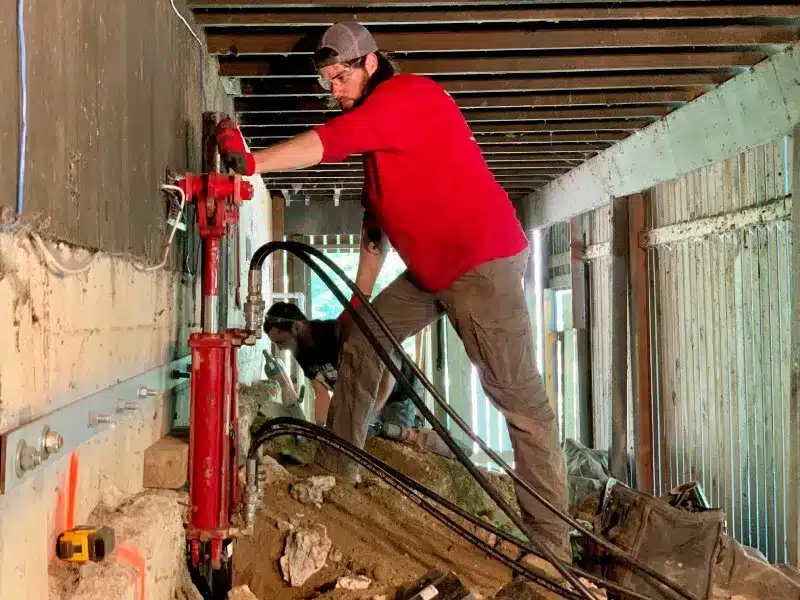
For heavier homes, push piers are the workhorse: sections of steel pipe are hydraulically driven straight down until they hit resistant soil, giving each pier enough capacity to carry its share of the structure’s weight. Learn more →

Structural House Jacking
With the piers set, our crew lifts the house on hydraulic jacks positioned at every support point and raises it in small, coordinated increments so the whole structure comes back to level together, not one corner at a time.
Related Foundation Solutions

Wall Repair System
If it is your foundation or basement wall that is bowing or cracking rather than the whole structure settling, our wall repair systems reinforce it in place. Learn more →
Crawl Space Supports
Homes on a crawl space foundation often need targeted support jacks under sagging joists rather than a full house lift. Learn more →

Crawl Space Repair
Moisture, mold, or joist damage in your crawl space can accompany settlement — our crawl space repair service addresses those issues directly. Learn more →
FAQs
About House Leveling
Is House Leveling the Same as Foundation Repair?
Not exactly. Foundation repair stabilizes your foundation and stops further movement, while house leveling raises the structure back toward its original position. The two are often paired — foundation underpinning anchors the foundation in load-bearing soil, and leveling brings your home back to grade.
How Do I Know If My House Needs Leveling?
Sloping floors, doors and windows that stick, and cracks that keep reappearing after patching are the clearest signs. A professional inspection can confirm how much your home has settled and what leveling plan it needs.
How Long Does House Leveling Take?
Most residential leveling jobs take one to two weeks depending on the size of your home and how many piers are needed, with minimal disruption to your daily routine.
House Leveling Is Easier With the Right Team
Uneven floors and stuck doors don’t fix themselves, and they rarely stay the same size for long. Book a free inspection and one of our local technicians will show you exactly what’s happening under your home and what it will take to bring it back level. If it is just a sunken driveway or patio rather than the house itself, see our concrete lifting page instead.
Testimonials
I don't even know where to start with this review. From the first contact to the end of the job, Ryan and his crew were amazing - professional, knowledgeable, courteous, tidy and clean and very respectful of the impact the job had on me as the homeowner. The job was major, but I felt confident with the information that Ryan and his crew shared with me each step of the project. Since they are specialists, they are very busy so it took a while from start to finish but worth the wait! I could not be more pleased. They get an A+++ from me.
Carol A.
We had a consultation with a very knowledgeable engineer (Collin) who's extremely patient to answer questions and concerns we had. After a thorough walkthrough and measurements, it turned out the area which we thought might be problematic with leveling is only centralized and minuscule, not foundation-related. I'd like to thank Foundation Solutions for this engineer's detailed explanations, professional knowledge and recommendations. At the end, we acquired peace of mind and would highly recommend this company to anyone that may be seeking help with foundation related issues. If we are doing any addition/expansion of our house, we would definitely get in touch again for securing our foundation.
Amy C.
Kyle and the team are awesome! A corner of our foundation has a horizontal crack and when we go out for a quote, many companies explained how serious it is and give us a high estimation. Kyle came onsite and did a detailed inspection, explain why it crack, and how to properly fix it. Then few days later, gave us a reasonable estimate, and we decided to go with the service, they handled the permit, came to fix it in a day and did all the final inspection and passed, we have a smooth experience on the fix. My family are super happy with their service and already recommend to friends in case they need some work in the foundation.
Yu A.